Dataset Reality Check ? Analysis Dashboard
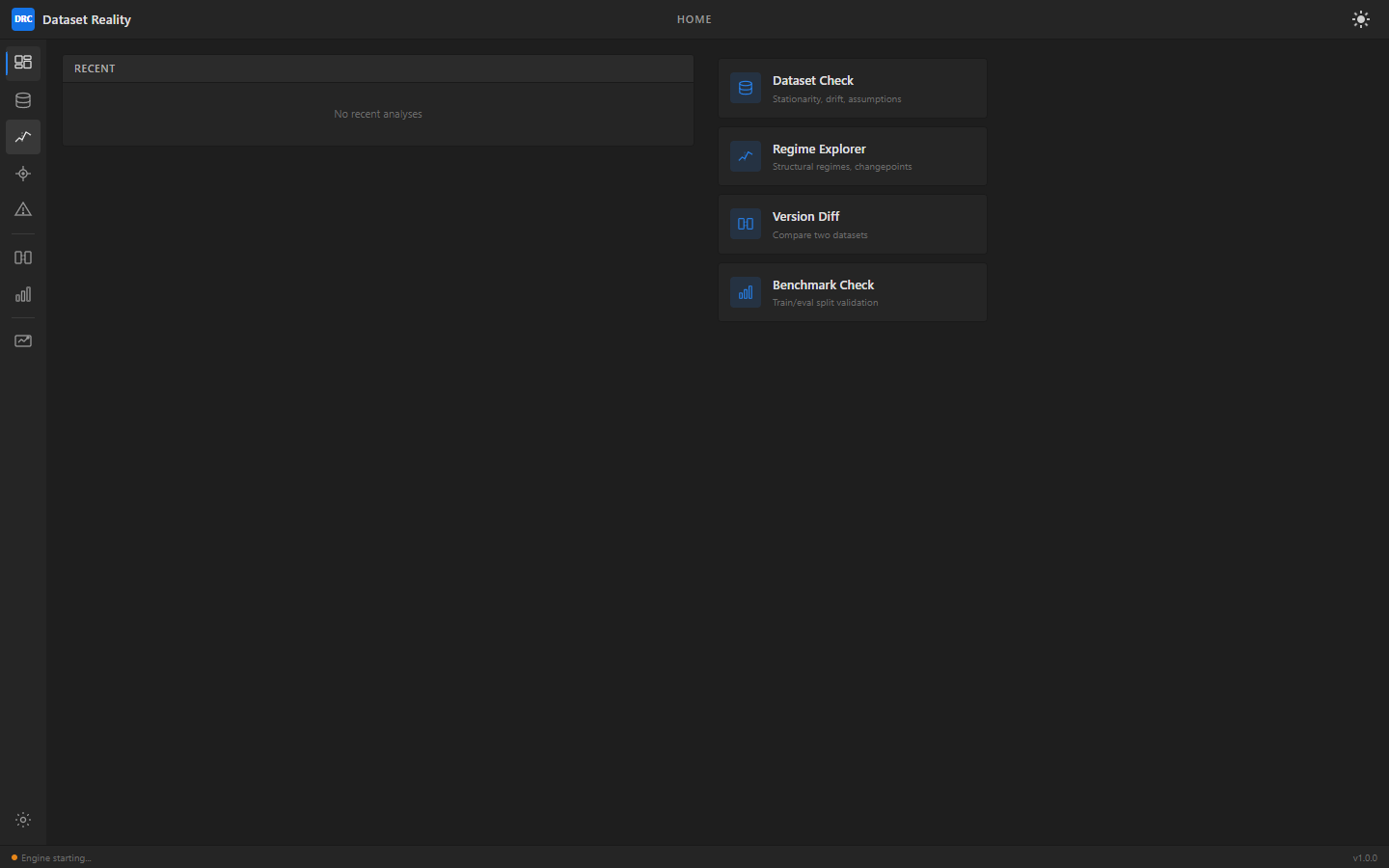
Custom-built AI stack focused on downside risk and failure prevention, not generic no-code automation. The engine does not depend on retrieval patching for memory. It adapts to validated new information in under a minute and commits only what passes a five-point source-truth gate.
Dataset Reality Check analyzes dataset quality before model training. Detect drift, regime shifts, feature fragility, and assumption violations so you don't waste weeks training on broken data.
Supports CSV, TSV, and Parquet · Up to 500 MB per file · Non-regulated uploads only for hosted launch
Most teams discover dataset problems after training fails. By then, you've burned compute, lost time, and still don't know what went wrong.
Your dataset changed between versions but nobody checked. The model trains on drifted features and performance degrades in production.
Dataset Reality Check → Version Diff catches schema and distribution shifts instantlyYour dataset contains multiple structural regimes mixed together. Training on mixed regimes produces a model that's mediocre everywhere.
Dataset Reality Check → Regime Explorer detects structural breakpoints before trainingYour training set and evaluation set come from different distributions. Benchmark scores look great but production performance is poor.
Dataset Reality Check → Benchmark validates train vs. eval compatibilityEach auditable capability chain is purpose-built for a specific stage of dataset validation, from first-pass triage to cross-version comparison.
Single-dataset quality review with three analysis modes. Quick for fast triage, Detailed for broader diagnostics, and Regime Detection for structural change focus. Generates stability index and prioritized concerns.
Structural break and changepoint analysis for a single dataset. Detects breakpoints, transitions, and identifies which features are affected by regime changes ? before they corrupt your model.
Compare two versions of a dataset side by side. Get an overall change score, schema change detection, and column-level shift severity ? so you know exactly what moved between dataset releases.
Test whether your training and evaluation sets are meaningfully aligned. Uses adversarial AUC and mismatch severity to quantify distribution gaps before you waste compute on misaligned splits.
Identify distribution drift across features ? from subtle statistical shifts to severe distributional changes. Severity levels from none/low through moderate and high let you prioritize what matters.
Export results as JSON for machine-readable pipelines or PDF for stakeholder reviews. Every analysis produces a complete, reproducible artifact you can attach to your model documentation.
From file drop to actionable insights in minutes ? not hours.
Drag and drop your CSV, TSV, or Parquet file (up to 500 MB). Choose a auditable capability chain: Dataset Check, Regime Explorer, Version Diff, or Benchmark.
The hosted analysis engine processes your uploaded file inside the Dataset Reality Check service. Select Quick, Detailed, or Regime Detection mode for the depth you need.
Review prioritized concerns, stability index, drift severity, and regime breakpoints. Export as JSON or PDF to share with your team or attach to model documentation.
Generic profilers describe your data. Dataset Reality Check diagnoses it ? telling you what will break your model, not just what your columns look like.
| Capability | Dataset Reality Check | Pandas Profiling / ydata | Great Expectations |
|---|---|---|---|
| Regime / changepoint detection | ✓ Built-in | ✗ | ✗ |
| Train vs. eval compatibility | ✓ Adversarial AUC | ✗ | ✗ |
| Cross-version diff with severity | ✓ Column-level | ✗ | Partial (schema only) |
| Feature fragility scoring | ✓ | ✗ | ✗ |
| Stationarity analysis | ✓ | ✗ | ✗ |
| Hosted SaaS with enterprise deployment path | ✓ DID-governed SaaS now, private deployment by quote | Python library | Python library |
| Actionable priority ranking | ✓ Top concerns | Warnings only | Pass/fail rules |
Comparison based on publicly available documentation as of March 2026.
The June 1 SaaS launch is for non-regulated datasets uploaded to the hosted service. Private, offline, and air-gapped deployments are handled through custom enterprise work.
Files are uploaded only for the analysis job you start. Hosted launch scope excludes PHI, payment card data, classified data, and other regulated datasets.
Offline, air-gapped, and restricted-network deployments are available by custom engagement after scoping data handling, support, and update requirements.
We use account, license, job, and system metadata to operate the service. Dataset contents are not used for advertising or training third-party models.
Hosted SaaS subscriptions are billed through Detailed In Design checkout. Save 20% with annual billing.
$1,910/yr with annual billing
For individual data scientists and small teams getting started with pre-model dataset validation.
$3,830/yr with annual billing
For ML teams that need the full auditable capability chain suite and advanced analysis capabilities.
$11,510/yr with annual billing
For organizations with compliance requirements and large-scale data operations.
All plans include free updates. No setup fees. Hosted launch excludes regulated datasets unless covered by a separate enterprise agreement.
No. Dataset Reality Check analyzes dataset quality before model training. It identifies issues like instability, drift, regime shifts, and assumption violations so you can fix your data first. It does not train, fine-tune, or evaluate models.
CSV, TSV, and Parquet files up to 500 MB. For best results, use clean headers, consistent schema, and avoid duplicate column names.
Yes, for the hosted SaaS launch you upload the file you want analyzed. Use only non-regulated datasets unless a separate enterprise deployment and data handling agreement has been scoped.
Air-gapped and offline deployments are available as custom enterprise work. They are not part of the self-serve June 1 hosted SaaS launch.
Quick is the fastest pass, ideal for first-pass triage of a new dataset. Detailed runs broader diagnostics across more dimensions. Regime Detection focuses on structural changes and breakpoints in your data. Start with Quick and escalate to Detailed if issues are unclear.
The June 1 launch runs as a hosted web application. Private desktop, offline, or on-premise packaging is handled through a separate enterprise deployment.
Generic profilers describe what your data looks like. Dataset Reality Check diagnoses what will break your model ? regime contamination, train/eval mismatch, feature fragility, and structural drift. It's purpose-built for pre-model validation, not just data exploration.
Start with DID-governed checkout for hosted, non-regulated dataset analysis.