What was reported
Nous Research, behind the open-source Hermes Agent, confirmed on October 7, 2026 that it raised $90 million. The Wall Street Journal reported the round first, describing it as a Series B at a $1.5 billion valuation; TechCrunch confirmed the details the same day. Nous's own announcement, a note from CEO Dillon Rolnick, confirms the raise but states no valuation, so the valuation and Series B label come from the Journal and TechCrunch reporting, not the company.
The valuation is not new. TechCrunch reported on July 13, 2026 that Nous was in talks to raise at $1.5 billion. What changed on October 7 is that the round closed: a confirmation, not a revelation.
TechCrunch reports Robot Ventures led the round, lifting total funding to about $158 million. Its reporting also names Nvidia, Union Square Ventures, Menlo Ventures, Samsung, and 1789 Capital, where Donald Trump Jr. is a partner.
The capital funds an enterprise push the company calls Hermes for Businesses. One precision: Hermes for Businesses did not launch on October 7. Nous announced Hermes Business and Hermes Enterprise accounts on September 14, 2026, on its X account. The new development is the confirmed close and funded enterprise push.
Hermes Agent is open source under the MIT license and was released in February 2026. The company says Hermes has been cloned more than 24 million times and, by its own internal estimates, drives roughly 2.5 percent of global AI token usage; neither figure is independently audited.
Rolnick's note is plain about the round's size: "Somehow, $90 million is modest in modern fundraising."
What this means for your business
The section above is reporting; what follows is analysis from Detailed In Design.
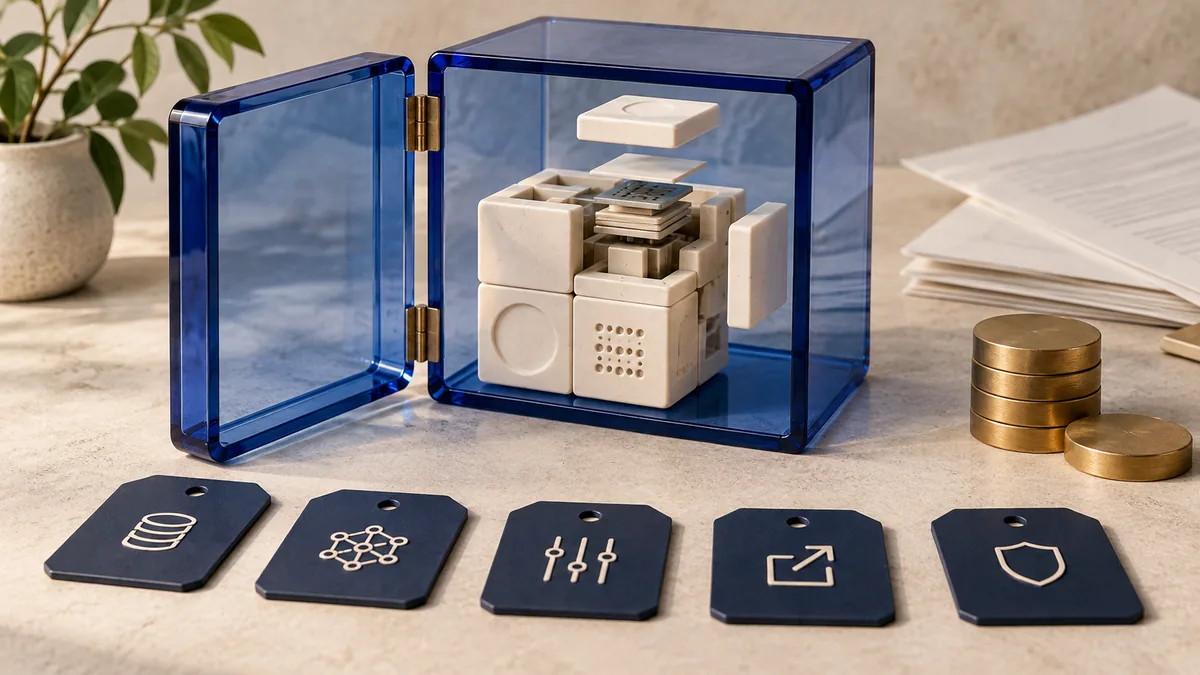
Nous's pitch rests on four claims: open licensing, secure data handling, model choice by price, and ownership of institutional knowledge. They are the right checklist for any AI agent vendor, Hermes or not: they separate a tool you rent from a system you own.
Open licensing sets the exit terms: an MIT-licensed agent can be inspected, modified, and self-hosted, so changed vendor pricing cannot lock you out of the code you depend on. Data privacy matters: an agent that learns your business will hold your business. Model choice matters because the model is the bill as much as the engine. Ownership of institutional knowledge matters most: an agent's memory of how your business works is an asset that should belong to you, exportable, and able to outlive the vendor.
Before signing with any AI agent vendor, ask five questions:
Who owns what the agent learns about my business, and can I take it with me?
Where does my data go, and can the agent run inside my environment?
Can I choose the model, and switch later without starting over?
What license covers the agent, and what happens if terms or pricing change?
Who reviews the agent's output before it reaches a customer?
Detailed In Design could build that evaluation as a custom system: a vendor-review workspace. It captures the five questions as a structured intake form, stores the vendor's written answers and contract terms as documents, and routes every answer through a named human reviewer before anything is signed. Deterministic software tracks which questions are answered, which remain open, and when each was reviewed. That is custom software and workflow automation, separate from any agent vendor.
The expected benefit is a written record of what a vendor promised about data, licensing, and ownership before money changes hands, with a clear owner for every open question. The limitations are real: the workspace organizes the evaluation; it does not test the agent, audit the vendor's claims, or replace legal review. It depends on written vendor answers, accurate intake, and completed reviews.
A practical next step
Detailed In Design builds custom AI, custom software, and workflow automation around approved data, defined review steps, and written ownership terms. On our website plans, you own your domain, your content, and our custom code; we never use client data to train third-party models. Weighing an AI agent? Start with the five questions above, and talk to us about the build.
Attribution and scope
The $1.5B valuation and Series B label are attributed to WSJ and TechCrunch reporting; Nous's note confirms the $90M raise but states no valuation. The Rolnick quotation is the complete first sentence of the note's second paragraph, quoted exactly and shortened at a sentence boundary. The 24 million clone and 2.5 percent token-usage figures are Nous's internal estimates, and the 1789 Capital and Donald Trump Jr. detail is from TechCrunch only. The Journal article's author and exact publication time were not verifiable from the paywalled page, so it is cited in APA no-author form with a date only. This article is an attributed synthesis of published reporting; Detailed In Design conducted no original field reporting.
Sources and original reporting
- Rolnick, D. (2026, October). A note on our fundraise. Nous Research.
- Temkin, M. (2026, October 7). Nous Research confirms it hit $1.5B valuation, launches AI agents for business users. TechCrunch.
- Nous Research scores $90 million to bring open-source AI assistant to enterprises. (2026, October 7). The Wall Street Journal.
- Mehta, I., & Temkin, M. (2026, July 13). Hermes Agent maker Nous Research in talks for new funding at $1.5B valuation. TechCrunch.
- Nous Research. (2026, September 14). Hermes Agent is open for business. Nous Portal now lets you invite colleagues to a Hermes Business account: your team [Post]. X.
Share this story
Use More apps or Copy link for Instagram, Threads, YouTube, and other platforms.