What was actually announced
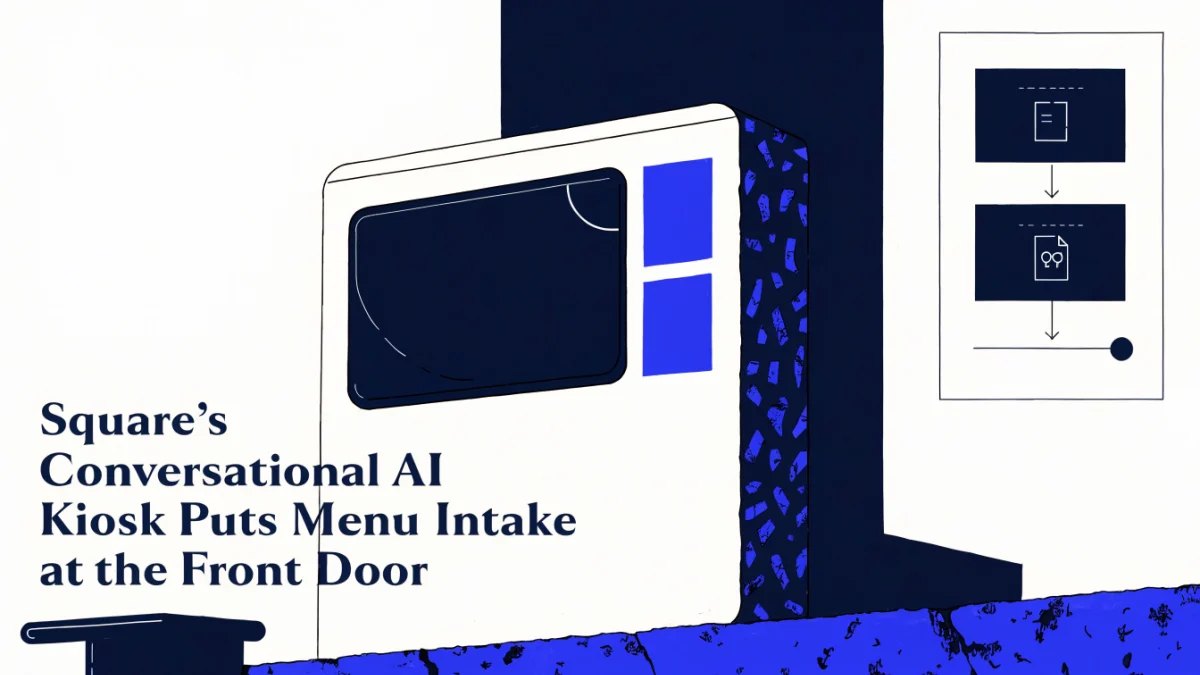
Square announced the new Square Kiosk on October 14, 2026, describing it as its flagship self-service device. The vendor's press release states that an agentic, conversational voice layer understands a seller's menu and responds in real time, so customers can ask menu questions, request suggestions, and work through modifications and substitutions, moving between voice and touch. The hardware includes a 21.5-inch touchscreen with presence detection, contactless payments, and a barcode scanner. The Verge's report by Jay Peters, published the same day, corroborates the launch and the capabilities as described by Square.
Square says the kiosk is available beginning October 14 for $1,999 with a Square Plus or Premium subscription, plus a $99 monthly software fee per device. The vendor's pricing footnote adds that the quoted price includes a counter stand and that the required plan costs $49 per location per month for Plus or $149 for Premium. Advertised pricing and availability can change; we verified them only at retrieval time on the day of the announcement.
The performance claims deserve the same care. Faster lines, contextual upsells, higher order values, and reduced strain on staff are statements from Square and from two restaurant operators quoted in its press release. They are not independently measured results, and neither cited source provides independent performance testing. How the voice layer handles allergy information is a vendor description of intended function, not a verified capability.
What this means for your business
The useful lesson is not that every restaurant should buy a kiosk. It is that conversational self-service pushes one requirement to the front of the house: the conversation is only as good as the structured data behind it. A voice layer that answers questions about ingredients and substitutions is trustworthy only when current menu and ingredient records feed it, and when anything the machine cannot resolve has a clear route to a person. Square released its own hardware and software. The workflow described below is a proposed custom Detailed In Design system; it implies no partnership with Square, no ownership of the kiosk, and no existing deployment, and we have not verified any public API into the kiosk's voice layer, so nothing here suggests our build would modify it.
Consider the catering and event side of a restaurant, where the intake problem is quieter than a lunch rush but just as costly. Requests for a thirty-person office lunch arrive through a contact form, a phone call, and a social message at the same time. Guest counts, dates, dietary restrictions, and delivery windows get retyped into a shared calendar and a quote sheet, and the errors surface when someone calls to confirm. Detailed In Design could build a website-connected catering and event intake system: a structured form capturing guest count, date, service style, and menu requests; a draft summary assembled from approved menu data so staff quote from current prices; an approval queue routing allergy questions, unusual substitutions, and large orders to a named reviewer; and, where the owner grants permission and provider APIs allow it, handoff of approved quotes into scheduling and billing.
The expected benefit is structural rather than numerical: consistent intake, clearer ownership of exceptions, and fewer repeated handoffs between whoever reads the form and whoever writes the quote. We make no claims about line speed, order values, or labor savings, and we have not benchmarked this against Square or any other product. The dependencies must be budgeted: accurate menu and ingredient records maintained by the owner, merchant permission and scoped credentials for any integration, provider subscription costs separate from our work, privacy and retention rules for customer contact details, and a staffed fallback when a request is ambiguous. No software should act as an allergy safety authority. Allergen answers must come from approved records and be reviewed by trained staff.
The pattern behind the product
Square's own framing makes the pattern plain. The press release describes existing touch-only kiosks as partial solutions whose gaps include staff needing to step in when something goes wrong, and presents its new device as closing that gap. That limitation of existing devices, not a tested feature of the new kiosk, is what our analysis builds on. Every intake system that works, kiosk or website form, has the same shape: capture the request in the right structure, draft from approved records, route exceptions to a person, and keep evidence of who approved what. The review gate is the product.
If your business takes catering, event, or custom-order requests through scattered channels, the practical next step is a short map: where requests land today, which details get lost before the quote, and which questions must never be answered without a human. Detailed In Design scopes the smallest reliable build around that map. You can read about our custom systems on our home page or see how we approach site and intake design on our web design page.
Sources and original reporting
Share this story
Use More apps or Copy link for Instagram, Threads, YouTube, and other platforms.