What the release actually says
The vLLM Semantic Router team announced Decision 3.0 on October 11, 2026, in a post from project maintainer Xunzhuo Liu that links to a public Hugging Face collection. The collection lists six variants, including d3, d3-flash, d3-mini, d3-nano, d3-lite, and d3-edge. The d3-nano model card describes a small model, built on a Qwen3.5-2B base, that accepts text and JSON alongside images and video, and answers three kinds of questions: choose among named options, answer yes or no, or return a score. It returns a probability for each answer and does not generate prose. The license file for d3-nano is the Apache License, Version 2.0.
The model card frames the use case in operational terms. Its quickstart walks through routing a customer request about a damaged order and checking a receipt image, which is a different job from the chat assistants most business owners encounter. A decision model does not draft the reply to the customer. It proposes how the request should be categorized, and a probability says how strongly the model leans toward that category. The card also notes that integration with the team's Router Engine is in a development channel until a stable release includes it, so the published models and the engine workflow should be treated as separate commitments.
A separate practitioner post from Victor M, who identifies as Hugging Face's head of product, demonstrates a screenshot-driven game in which the model chooses directional actions for harvesting apples. The post is practitioner-reported and does not state where the model ran; the author represents the hosting platform that hosts the models, and the example is a toy demonstration. It shows the interface working; it does not establish business accuracy, latency, or superiority over alternatives. Vendor posts describe the models as state of the art. No independent replication of any benchmark was performed for this article, so those claims are not repeated here as fact.
What this means for your business
For a company that receives service requests through a portal or email, the interesting part of this release is the shape of the output, not the headline. When incoming requests mix text, photos, and receipts, staff must sort them into returns, billing, and technical categories before anyone reviews or acts. A decision model that returns a constrained choice with a probability is easier to connect to that queue than a chatbot that writes a paragraph, because the queue can act on a category and a numeric value directly. That value is the model's own probability, not a calibrated confidence score, so any threshold built on it needs testing before it can be trusted to route on its own.
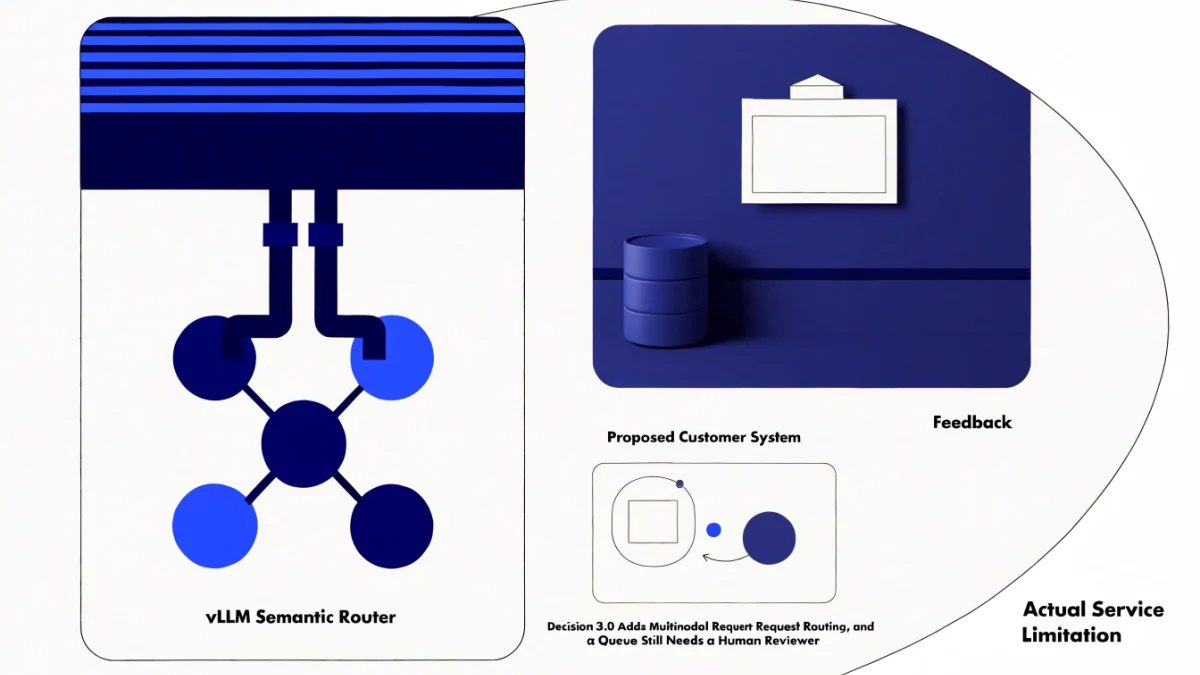
Detailed In Design could build that workflow around a suitable evaluated model. A customer portal intake queue would send approved text and attachments to a self-hosted decision model, recommend a routing category, store the model's answer next to the original evidence, and route uncertain or consequential cases to a person before any CRM update, refund, or outbound message happens. Done this way, the system can support more consistent handoffs and a clearer review record; the result depends on the categories, the validation, and the reviewers. The limitation is equally concrete: a probability is not proof, the model can be wrong, and the routing choices must be defined, tested on representative client requests, and paired with escalation rules before the system touches real customers. Hosting costs, image quality, privacy and retention decisions, authorized CRM access, and review of downloaded custom code and Apache-2.0 obligations all sit in front of any pilot. No hosted inference endpoint was verified in this research, and Detailed In Design has no relationship with the vLLM Semantic Router team.
A concrete example makes the boundary clear. A customer uploads a photo of a damaged part with a short note. The decision model proposes a returns category with a probability. The queue shows the photo, the note, and the proposed category to a reviewer, who confirms or corrects it before the refund or the reply goes out. The model can shorten the sorting step when its proposals are accurate. The person still owns the consequential action.
A restrained next step
If request triage is a real bottleneck for you, the useful first step is not installing a model. It is writing down the categories your staff already use, the evidence that accompanies each request, and which actions require a human. That specification is what makes any routing system, this one or another, auditable. Detailed In Design can help you map that intake workflow and run a scoped pilot against your own requests, with human approval kept on every consequential action.
Sources and original reporting
- vLLM Semantic Router team: d3-nano model card
- vLLM Semantic Router team: Decision 3.0 model collection
- vLLM Semantic Router team: d3-nano Apache-2.0 license file
- Xunzhuo Liu: Decision 3.0 release announcement on X
- Victor M: Decision 3.0 practitioner demonstration on X
Share this story
Use More apps or Copy link for Instagram, Threads, YouTube, and other platforms.